Yoshitaka Kuki | Toba's Legendary Pirate Lord
Updated: Aug 6
By Toshio Hanatani
Local in Toba

From the 16th century, the bays stretching from Toba to Shima were the stomping grounds of fierce pirate clans competing for supremacy. Rising from these ranks was Kuki Yoshitaka, a brilliant leader who eventually became a legendary naval commander and built Toba Castle. It was a "Sea Castle," surrounded by water on all four sides, designed so that ships could sail directly into the ocean. With a bit of background knowledge and a touch of imagination, walking through these ruins today feels like stepping into a cinematic epic.
The Real-Life Pirates of the "One Piece" Era
Near Toba Station, the Toba City History and Culture Guide Center hosts a permanent exhibition on Kuki Yoshitaka. Here, you can see rare artifacts like samurai armor, helmets, and original wooden panels from ships. Best of all, by scanning the QR codes on the panels, you can read all the detailed descriptions in English.
For a deeper dive, visit the Toba Sea-Folk Museum to see intricate models of the Kuki Navy’s fleet and a diorama of the castle town.
If you prefer to go straight to the source, head to the Sannomaru Plaza at the castle's main entrance. The signboards there include English translations, and you can pick up a "Toba Castle Layout Map" leaflet from the nearby box. This map is the key to visualizing the castle's original boundaries.
One legendary scene mentioned in these records is the Second Battle of Kizugawaguchi in 1578. Yoshitaka, serving the great warlord Oda Nobunaga, clashed with the Murakami Navy—the most powerful pirates of the Seto Inland Sea. While most Japanese ships of the era were made purely of wood, Yoshitaka is said to have built massive "ironclad" ships reinforced with iron plates to repel the enemy's fire.
Doesn't this sound like a setting that could rival the excitement of the pirate manga ONE PIECE? Let’s begin our journey of history and imagination!

Standing at Shiroyama Park: What Do You See?
The Toba Castle ruins sit atop a 40-meter-high hill. Just up the stairs from Sannomaru Plaza is Shiroyama Park. It offers a stunning vista of islands scattered across the blue sea and is a premier cherry blossom spot in the spring.
It’s important to note that many of the stone walls here were reconstructed or altered during land reclamation in the Meiji period, so they don’t entirely reflect the original structure.
So, what did it look like back then? If you overlay the layout map from your leaflet onto the modern landscape, you’ll see that the area near the edge of the Toba Aquarium (across the tracks from Sannomaru Plaza) was once the Main Water Gate. Close your eyes and imagine the massive Atakebune (warships) bearing the Kuki family crest—the "Left-Turning Tomoe"—setting sail, or small fishing boats pulling up to the shores of Sakatejima Island across the water.
Looking Toward Yoshitaka’s Final Resting Place
At the highest point, the ruins of the Honmaru (Inner Ward) are supported by stone walls built in the Nozura-zumi style—where natural, unshaped stones are piled irregularly. This is quite different from the seamless, perfectly fitted walls seen around the Imperial Palace in Tokyo. These are precious remains likely dating back to the late 16th century when Yoshitaka first built the castle.
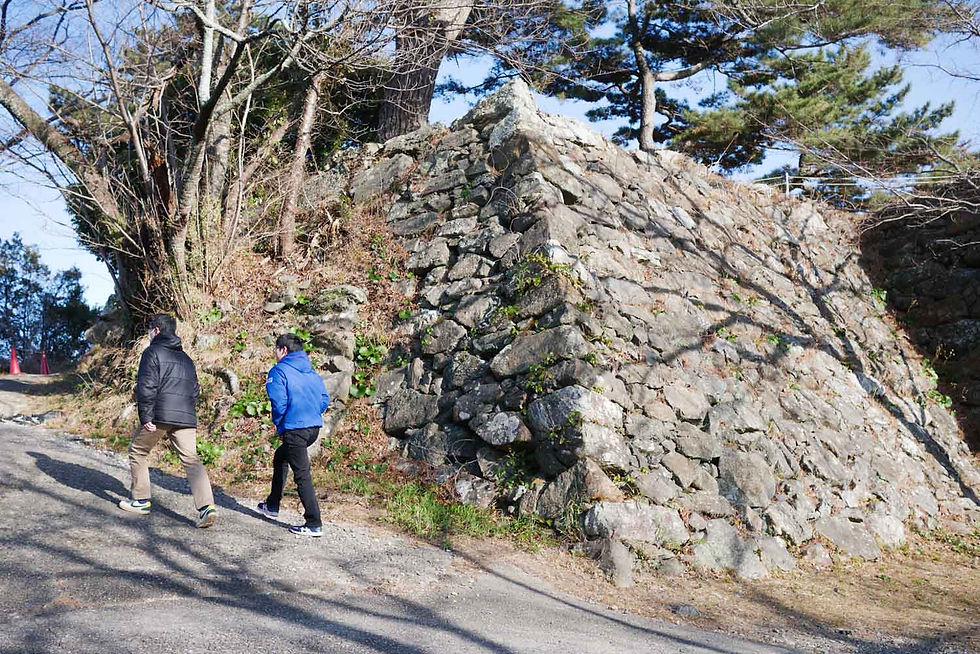
The top of the Honmaru is now a cleared, open space with no buildings left. This is where your imagination truly takes over. In the year 1600, the Battle of Sekigahara divided all of Japan into two factions: Toyotomi and Tokugawa.
Although Yoshitaka had already retired, he rose up for the Toyotomi side, while his son, Moritaka, joined the Tokugawa side. This forced father and son to point their blades at one another. When Yoshitaka's side was defeated, he fled to Toshijima Island and prepared to commit ritual suicide (seppuku). Though his son Moritaka successfully pleaded for his father's life, the pardon arrived too late. Yoshitaka was 59.
Why did Yoshitaka choose to fight against his own son and successor? You can find many scholarly theories in books, but standing here, looking out toward the islands beyond the withered grass, I find myself in a silent dialogue with the old commander.

The "Dance of the Lion and Tengu": Connecting the Past to the Present
As you descend from the Honmaru toward the red steel tower, you will find a shrine nestled among towering trees. This is Oyamazumi Shrine. Its spring festival is held annually in early April when the cherry blossoms are still clinging to the trees. During the weekend, the "Dance of the Lion and Tengu" is performed in the shrine grounds and the surrounding streets (though please note it is performed on a rotating schedule and may not occur every year).
This dance is said to have originated when Yoshitaka prayed for safety during the castle's construction, and the local residents have protected this tradition for over 400 years. It is a vital bridge connecting the war-torn era of the castle’s birth to the peaceful park it has become today.

Go Deeper: The legacy of Kuki Yoshitaka extends beyond the city center. For those who want to follow the trail of his turbulent life even further, take a train or bus to Kuki Iwakura Shrine, or hop on a local ferry to Toshijima Island to visit his Head Mound and Body Mound.


