From Sea to Table | The Journey of an Uramura Oyster
Updated: Aug 6
By Toshio Hanatani
Local in Toba
Sweet and Creamy: The Gift of Forest Waters and the Soul of Toba’s Oyster Farmers
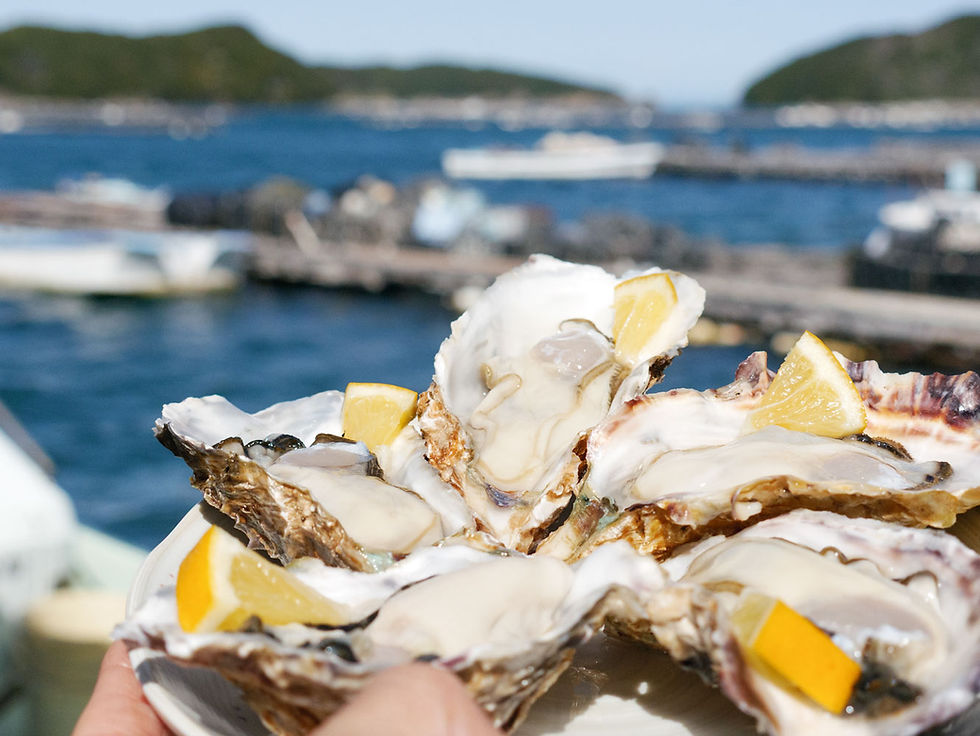
Moshio Bay produces approximately 2,000 tons of oysters annually—accounting for two-thirds of Mie Prefecture's total production. Their flavor is hailed as "sweet and creamy." But why do oysters thrive so exceptionally well here in Toba? We interviewed local producers to uncover the secret behind this world-class taste.
The Joy of the Oyster Farmers of Uramura

The Pearl Road is often called the "Oyster Road." As you drive along, oyster huts appear one after another, overlooking Moshio Bay where around 2,000 cultivation rafts float on the gentle waves.
During the harvest season from autumn to winter, Yoshinori Nakamura, a third-generation farmer at Maruzen Suisan, sets out on his boat in the early morning. Upon reaching the rafts at the mouth of the bay, he hoists the long ropes suspended in the water. The oysters, grown large and covered in seaweed and silt, are brought up by machine, cleaned, and piled into large steel crates before heading back to port.
Maruzen Suisan is a family affair, including Nakamura’s father, Shuichi. During the peak season, the team expands to include international technical interns, all working busily at the portside factory to sort shells and shuck the oysters (a process called kaki-uchi).
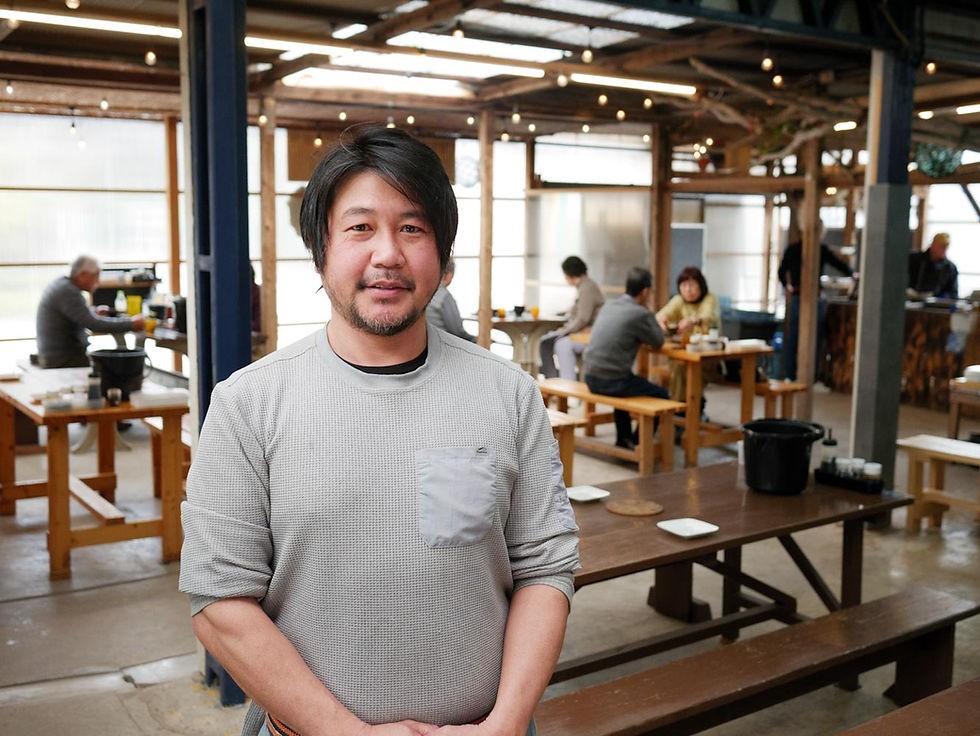
Nakamura himself is a trained chef, so he also steps into the kitchen of the adjacent oyster hut. "Most producers don't get to see people eat what they’ve made, but here, I hear 'It’s delicious!' directly from the customers," he says with a smile. "I love the air and the scent of the sea here—it’s a truly great job." When asked about working with his family, he playfully dodges the question with a grin on his sun-tanned face: "Well... I wonder about that!"
The defining characteristic of Uramura oysters is that they are "One-Year Oysters." Seeded in spring, they are ready for harvest by autumn of the same year. Unlike the 2-year or 3-year oysters from other regions, these have a pure, creamy taste without any bitterness. This is why Nakamura insists, "You absolutely must try them raw."
Note: Mie Prefecture enforces strict safety standards; all oysters intended for raw consumption must be purified in sterilized seawater for over 18 hours before shipment.

The Cycle of Nutrients Between Forest and Sea
The secret to the oysters' growth lies in the currents. Moshio Bay receives nutrient-rich water from the Kiso Three Rivers via Ise Bay, mixed with fresh inflows from the open sea.
Daisuke Asao of Uramura Sea Farm, who moved from outside the prefecture to start fishing from scratch, explains: "The water here is a deep forest green. That’s proof it’s teeming with the plankton that oysters feed on." Unlike the veteran Nakamura, Asao has studied the sea through a scientific lens, seeking advice from experts and seniors.
Recently, Asao organized local volunteers to start rice farming in the fields tucked deep behind the bay. His goal? To enrich the water flowing from the local mountains into the sea. "In this ria coastline, the forest and sea are intimately connected. By fertilizing and tilling the fields to create 'good water,' we increase the nutrients that feed the phytoplankton," Asao explains. The rice he grows is served at the restaurant "Kaki-ichi Daikichi-ten." "Uramura rice is delicious," he adds with the pride of a true farmer.
A Sacred Spring That Feeds the Oysters
As a writer, I felt the "sincerity" of these two men—their respect for the natural cycle between the forest and the sea—is what truly seasons these oysters. To experience this yourself, visit Ura Shrine near the "Imaura" bus stop on Pearl Road.
The shrine's deity is a massive 30-meter-high rock that has watched over the fishermen for generations. Behind the main hall, a steep path leads to a small waterfall trickling from the rocks. You can watch the water flow into a small channel and directly into Moshio Bay. This is a literal "lifeline" from the forest to the oysters. After seeing this sacred flow, the taste of the oysters feels even richer.

Go Deeper: While we’ve focused on "Oyster Hut" restaurants here, you can find creative oyster dishes at various cafes and specialty restaurants throughout the Uramura area. Even in the summer off-season, some shops remain open, serving large Rock Oysters (Iwagaki) and other fresh seasonal seafood.


