Toshi Island Festivals | The Maruhachi Mark & Jinji
Updated: Aug 6
By Motomi Nakamura
Local in Toba
Jinji: A Wild and Majestic Festival Rooted in the Deep Faith of the Islanders

The Annual Grand Festival of Hachiman Shrine in the Toshi district—known to locals simply as "Jinji"—is the island's most significant event. Held from the 17th to the 19th day of the first month of the lunar calendar (currently the closest weekend), it is a powerful celebration to pray for bountiful catches and family safety. Islanders and those returning home unite to offer sacred rituals and performances to please the gods, creating an atmosphere charged with both vibrant energy and solemn tradition.
The Most Exciting Day of the Year in Toshi
While officially called "Jinsai," the early spring festival of Hachiman Shrine is affectionately called "Jinji" (meaning "sacred ritual") by the people of Toshi. The absolute highlight is the Yumi-hiki (archery ritual) on the third day. At the dedicated "Jinji Stage," the air crackles with tension as the men's enthusiasm reaches its peak. As the Omatoshu (target-bearers) sprint up the slope, the Negi-don (ritual archer) draws his bow in perfect synchronization. The hearts of all islanders beat as one while they watch this sacred moment.

"The first day is the 'Stage Opening.' The youth division removes the shutters, installs the hanamichi (runway), and sets up the spectator area. It’s their responsibility to prepare the space for performances and rituals," says Toyoyuki Nishikawa, President of the Toshi Neighborhood Association. "A fence of brushwood is built around the stage, and shimenawa (sacred ropes) are hung. Access is strictly restricted for women and those in mourning during the rituals. Everything follows rigorous traditional laws until the ropes are cut after the archery." The stage is a sanctified space, and everyone with a role must undergo ritual purification.
The Climax: The High-Intensity "Yumi-hiki" Ritual
The core of the Jinji involves three groups: the Omatoshu, the Negi-don, and the Shichinin-tsukai. "Once the festival begins, these men stay in dedicated 'lodgings' where women are not allowed," explains Norimichi Hashimoto, Director of the Toshi Branch of the Fisheries Cooperative. The cooperative is a central pillar of the festival, and their office serves as one of these sacred lodgings.
The stars of the climax are the Omatoshu. Before dawn on the final day, they perform Kori-o-kaku, a purification ritual where they plunge into the freezing winter sea. They then construct the Omato (Great Target) on the eastern beach, using wooden frames, Japanese paper, and a mixture of charcoal and glue to paint a large "Maruhachi" symbol (the character for 'eight' inside a circle). Carrying this massive target, they charge up the hill to the stage. Just before the entrance, they present the target, and waiting islanders scramble with incredible intensity to tear away pieces of the charcoal-stained paper.

The Shichinin-tsukai is a youth group that manages the ritual's progress. Though traditionally seven members, it is now scaled to the most vital roles due to a shrinking youth population. They also perform sea purification before visiting the shrine. Led by the "Salt-Sprinklers," they carry the bow, giant Secchi rice cakes, and sacred sake to the stage, ensuring everything is ready for the Negi-don.
The Negi-don bears the heavy responsibility of performing the ritual archery. "He must time the bow-shot perfectly with the arrival of the Omatoshu. It requires extreme precision; there is no room for failure," says Yoshiyuki Hashimoto, Manager of the Toshi Branch. Together, these groups protect the island's most important ritual, passing down prayers for prosperity to the next generation.
A Divine Crest: Prayers Inscribed on Homes and Boats
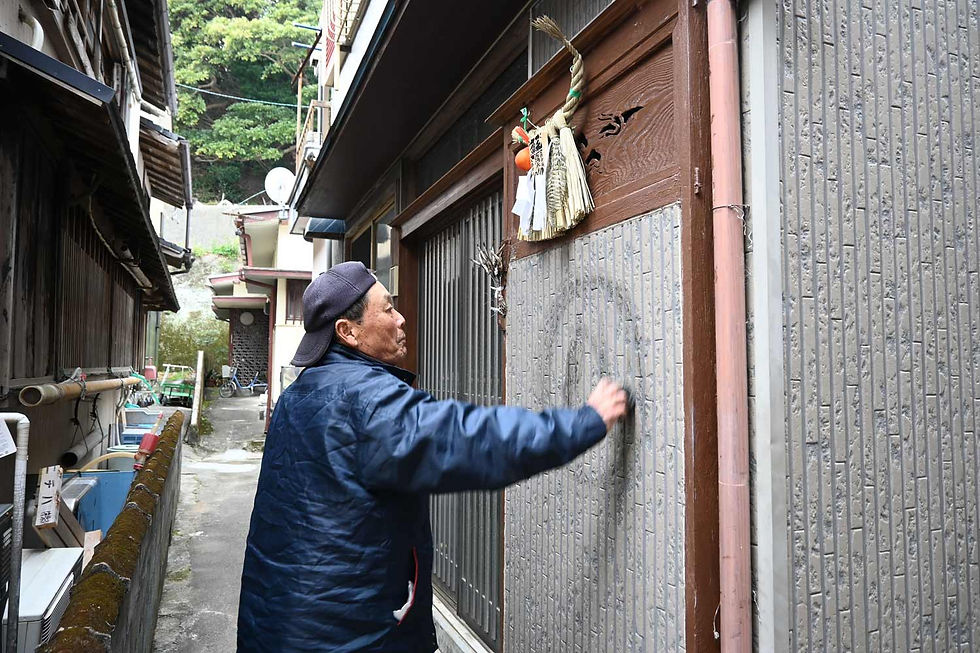
Once the target arrives and the archer mimics his shot to divine the year's fortune, a fierce battle breaks out. Young men waiting for the end of the archery tear at the target with all their might. They use the captured charcoal to draw the "Maruhachi" mark on their front doors and the hulls of their fishing boats. This is the divine crest of Hachiman Shrine—a powerful charm to ward off evil for the coming year.
After the archery, the sacred ropes are removed from the Jinji Stage, and the air turns festive as lions dance to flutes and drums. The festival is also the ultimate stage for the "Neyako" (the island's unique youth brotherhood). These young men practice every night for over a month to perform plays and dances. In the past, when there were many Neyako groups, the entertainment would last until late at night. Jinji is more than just history; it is the heartbeat of the islanders. Every "Maruhachi" mark found in the back alleys represents a prayer to the gods and a deep trust among comrades.

A unique feature is the Dai-hannya Buddhist service, a remnant of a time when Shinto and Buddhism were intertwined. The festival begins and ends with the chanting of these 600 scrolls of scripture. Historically, the youth division would carry these heavy boxes (20kg each) on their shoulders from the temple, shouting "Wo-i, oi!" as they moved. While cars are often used now, that call signaling the start of the festival is etched into the islanders' souls.
"We wear formal montsuki hakama, holding a folding fan and Buddhist prayer beads. It’s like a wedding and a funeral occurring simultaneously—a style unique to this moment," says Manager Hashimoto. This blend of Shinto and Buddhist ritual is a rare, living window into Japan's ancient forms of faith.
Go Deeper
For the islanders, Jinji is a precious time to "make the gods happy." The theatrical performances on stage are the result of over a month of dedicated nightly practice. If you walk through Toshi Island on a winter evening and hear the sounds of rehearsal, you will feel the profound passion the islanders hold for their tradition.


